









The need for higher data rates means that current radio technologies (wireless, mobile radio) use high modulation bandwidths and high modulation orders. These need excellent signal-to-noise ratios in their radio systems, sometimes pushing important radio HF components to their physical limits. The dynamic level and frequency range in today’s signal and spectrum analyzers are not sufficient to characterize components under such demanding conditions. Cross-correlation can help but requires larger measurement setups and greater workloads when measuring.
R&S FSWX: a new class of signal and spectrum analyzer
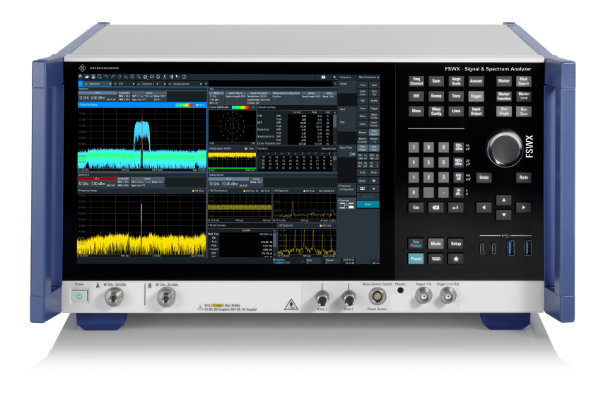
The FSWX was developed with all these factors in mind. It is the first signal and spectrum analyzer with two input ports. The integrated cross-correlation mode takes measurement accuracy beyond the capabilities of previous signal and spectrum analyzers without the need for a second signal analyzer. A third major innovation is using filter banks to replace the classic YIG pre-filter in the microwave range. This new device architecture increases dynamic range, simplifies measurement setups and shortens measurement times.
Two input ports
The FSWX lets several signal sources be connected simultaneously – whether they operate at the same or different frequencies – opening a wide range of new measurement scenarios. The two synchronous input ports, each with a remarkable 4 GHz analysis bandwidth, let users seamlessly analyze interactions between diverse signals.
The FSWX’s multiple input ports can be used to decode the MIMO signals in modern communications applications or phase-coherent measurements on antenna arrays for beamforming in wireless communications and radar sensors in the aviation and the automotive sectors. Here, the phases of individual channels are compared for precise analysis. Although conventional vector network analyzers (VNA) work here, FSWX has the benefit of being fully standard-compliant for the analysis of modulated broadband signals.
A signal can also be immediately compared with a reference signal, such as a power amplifier with its input (Fig. 1).
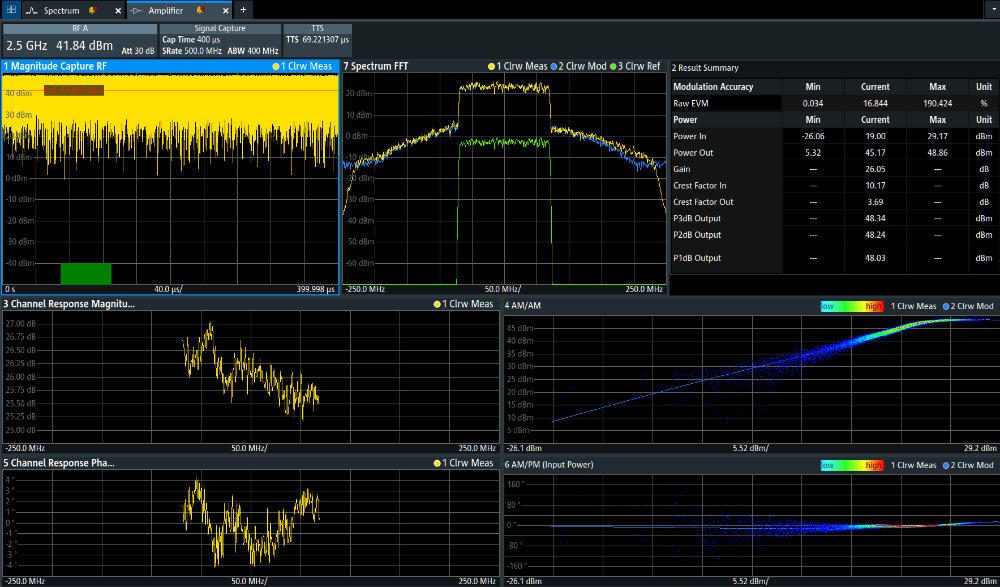
Fig. 1: Amplifier measurements: a direct comparison of the output and input signal provides all relevant data such as residual EVM, 1 dB compression point (AM/AM) and group delay.
Distortions from the amplifier, including frequency response and non-linearities, become immediately visible. No prior knowledge of the reference signal is needed. The FSWX combines the benefits of conventional signal analyzers with a VNA by integrating an additional VNA and an external coupler, simplifying frequency-converting component characterization. Digital radio frequency memory (DRFM) can be characterized for electronic warfare to manipulate radar signals.
Cross-correlation mode
Integrated cross-correlation mode is based on the new multi-path architecture: a splitter internally divides a single-signal input into two independent signal paths, each with its own local oscillator and A/D converter. Sophisticated cross-correlation algorithms in the digital backend are highly effective at suppressing the inherent noise in a measuring device and measurement accuracy is far better than most signal and spectrum analyzers. Figure 2 shows an example.
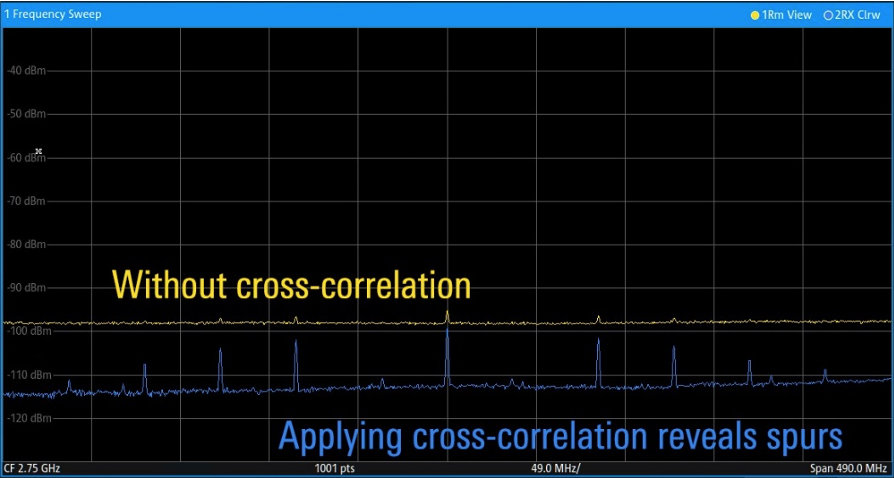
Fig. 2: Measurement with and without cross-correlation mode. Noise reduction makes secondary emissions visible that are otherwise difficult to detect.
Cross-correlation has been proven in phase-noise measuring stations, particularly in specialized test and measurement optimized for measuring phase noise. When integrated into signal and spectrum analyzers, cross correlation eliminates the need for extra phase noise testers in oscillators or synthesizer measurements. Oscillators and synthesizers are the vital for understanding phase noise in today’s communications applications and determining the potential data rate in practice. Read more in the box below.
How phase noise influences the data rate in communication systems |
|
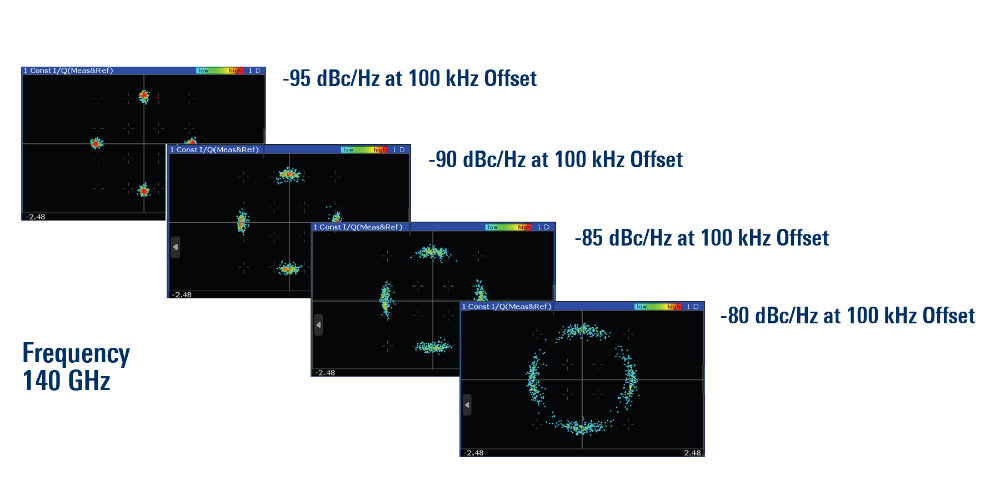
Today’s communications systems increasingly use higher frequencies for data transmission, which also increases the oscillator phase noise (by a factor of 20 * log (f)), making it more difficult to determine the correct point in a constellation diagram. If phase noise is too extreme, the communications system may switch to a lower-order modulation scheme and the data rate drops. Figure 2 shows a QPSK-modulated signal with 140 GHz center frequency in the constellation diagram as the phase noise increases.
Fig. 3: QPSK-modulated signal in the constellation diagram: The more phase noise, the worse the constellation points are hit. If the information is transmitted with a phase noise of -95 dBc/Hz at an offset of 100 kHz, correct decoding is already difficult at -80 dBc/Hz. The system must switch to BPSK modulation with reduced data rates. A phase noise of -90 dBc/Hz or better is required for QPSK. This is very demanding with a 140 GHz center frequency. To optimize oscillators and synthesizers here, high-quality measurement technology with cross-correlation is needed to measure phase noise. |
Using filter banks
Broadband modulation analysis is a typical task in mobile radio, satellite communications or when dealing with radar signals. There is currently a lack of good preselection functions for I/Q analysis in the microwave range. Spectrum analyzers in the microwave frequency range typically use YIG filters, which must be bypassed for I/Q analysis because of their multiple-decibel spectral ripple effect. As a result, noise or unwanted signals at the mirror frequency can impair measurement results. The FSWX has integrated filter banks that cover the entire operating frequency range with a flat frequency response that lets them be used for I/Q analysis. The filter banks also enable more accurate signal level measurements on CW carriers or branch lines. Because filter banks can be switched faster (roughly 50 MHz frequency width) than YIG filters can be swept, they have an advantage in spectrum analysis when searching for spurious emissions.
However, users who prefer the narrower bandwidth of a YIG filter can have the option available as an extension.
Application example: improving radar systems |
|
Current radar applications are designed to detect targets with a small radar cross-section (RCS) such as drones. The phase noise for the local oscillator in the radar system and the broadband background noise need to be improved. When this is done, the reflection of a small target could be made visible with a slight Doppler shift in the frequency, since it is no longer masked by interfering reflections.
Fig. 4: The FSWX is ideal for interference detection in radar systems. Recognizing small and unwanted secondary lines and disruptors in the system is also important. The confidence level for real targets needs to be higher because radars might misinterpret small signals as targets. Such noise reduces radar sensitivity. Signal and spectrum analyzers are used to detect such interference, but the resolution bandwidth (RBW) of the spectrum analyzer must be reduced to a few hertz to detect spurious lines close to the noise floor. The longer filter settling times make the sweep much slower and a long measurement time is needed to characterize the system. The FSWX is ideal here. The integrated cross-correlation enables much faster sweeps with less inherent noise to quickly and reliably detect interference. The phase noise for the local oscillator in the radar system is also easier to improve, since the cross-correlation suppresses the analyzer phase noise. |

Innovative firmware applications
The cross application control and triggering (CrossAct) in the firmware synchronizes different measurements on different input channels so that several signals can be analyzed simultaneously with multiple tools to quickly check whether the higher harmonics of a radar signal have an influence on 5G signal modulation quality.
The two-path concept enables new trigger options. Users can apply an IF or HF power trigger at different frequencies since independent frequency settings are possible for the two receive paths behind the splitter. The configurable local oscillators are just as flexible. They can be operated at different frequencies or switched to phase-coherent mode.
Executive summary
The FSWX has numerous new functions for high-end signal and spectrum analysis. The all-new device architecture includes wideband A/D converters, multiple input ports, cross-correlation and powerful filter banks. Test scenarios that were previously impossible are now possible. The FSWX has everything a future-proof premium measuring device for mobile radio, wireless and radar technology needs.
Dr. Wolfgang Wendler, Rohde & Schwarz